The Friendship Between Pietro and Bruno Guglielmina
The Eight Mountains: A NovelThe friendship between Pietro and Bruno Guglielmina is shaped by childhood companionship, a long separation, and a return to shared work in the mountains. Their closeness is seldom maintained through regular communication; instead, it persists through family connections, remembered places, and the eventual rebuilding of a house together. What begins as Pietro’s attachment to a companion who belongs to his summers becomes a relationship he chooses to recognize as mutual and enduring.
First Meeting and Childhood
Pietro first encounters Bruno through his mother’s efforts to draw the solitary boy into company. A few days after Pietro says that he likes both making friends and being alone, he finds Bruno having breakfast in the family kitchen. Bruno is only a few months older, and explains that although many people in Grana mountain village share his surname, his first name is unique there. Pietro learns that Bruno had also been watching him in the pasture: their apparent indifference had concealed a mutual curiosity. Bruno’s question about whether Pietro likes the river begins their conversation and marks the start of a friendship grounded in the landscape they share.
Pietro’s mother helps make that friendship possible. In Grana mountain village, she seeks out Bruno’s mother in the field where she works, then turns to Bruno’s aunt when she concludes that his mother will not help secure his education. By persistently visiting the family, she persuades the aunt to send Bruno to school in winter and to Pietro’s home for summer homework. Three times a week, the boys study history and geography in the kitchen. Pietro’s mother asks Bruno to read from books by Stevenson, Verne, Twain, and Jack London, and lets him keep them to practice in the pastures. Bruno enjoys novels but struggles with grammar and spelling. Pietro feels embarrassed for him and resents the lessons, yet Bruno does not complain; he works at them because he understands that his education matters to Pietro’s mother.
Their companionship develops alongside that educational effort, rather than simply as a result of it. The boys spend time together in the mountains and share a childhood world of rivers, woods, and ruins. When Pietro lies awake after one of their encounters, he recognizes an intimacy that both attracts and unsettles him, unlike the solitary childhood he associates with his father. He imagines Bruno listening to the same night sounds from his own bed. The friendship has become part of how Pietro experiences the mountain, even before he can fully understand what the bond means to him.
Separation and Unequal Expectations
The possibility of Bruno moving to Milan exposes a tension within their closeness. Pietro’s parents have spoken with Bruno’s uncle about the possibility, but Pietro initially denies knowing about it. When Bruno considers what life in Milan might be like, Pietro is already opposed to the idea. He believes Bruno would hate the city and fears that it would change the companion he associates with his summers in Grana mountain village. Pietro imagines the mountain remaining unchanged, with Bruno there as well, but later recognizes the selfishness in that wish: he has been thinking less about Bruno’s wishes and future than about preserving his own access to him and to their shared life.
The friendship is interrupted when Pietro stops returning to Grana mountain village. At the end of one summer, he watches Bruno leave on his motorcycle and understands that the departure is a farewell, though neither boy knows how long the separation will last. Pietro returns only briefly the following year, then stops going altogether. For years, the boys do not meet. The break does not resolve their friendship so much as leave it suspended: Pietro’s childhood companion remains tied to a mountain life from which Pietro has moved away.
The Return to Shared Work
When Pietro returns to Grana mountain village as an adult, Bruno comes to meet him early the next morning. Pietro recognizes the distance between them—Bruno is now a man he no longer knows, though the boy he remembers remains within him. Their reunion is not immediately a restoration of effortless childhood closeness. Instead, their shared history reappears through the work and places connected with Pietro’s father.
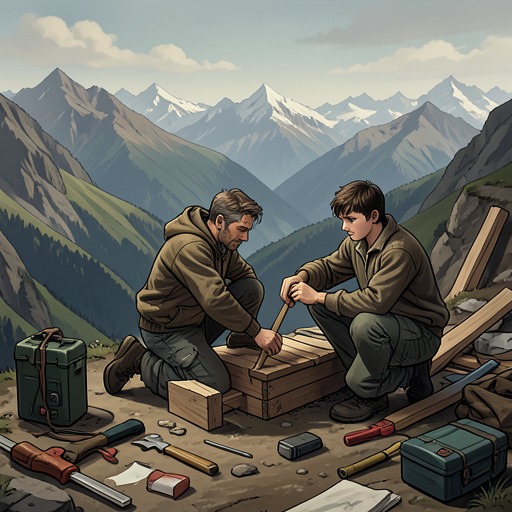
Bruno explains that he had accompanied Pietro’s father on searches for a ruin, and that the father had chosen the site almost three years earlier. Bruno then found the owners and persuaded them to sell, despite the reluctance of people in the area to part with old properties. The ruin becomes Pietro’s inheritance and the basis for the two men’s collaboration. Bruno asks for help finishing the work, estimating that with a laborer he could complete it in three or four months. Pietro accepts the invitation while wondering whether the project is another of his father’s riddles. He initially understands his presence as an attempt to fulfill his father’s wishes and ease his own guilt.
Working together changes that understanding. A familiar game from their childhood comes back to Pietro as Bruno demonstrates how to use a scythe stone: in abandoned ruins, the boys had entered through unstable openings, walked on shifting planks, and treated discarded objects as treasure. Seeing Bruno’s gesture revive that shared play, Pietro begins to regard the inheritance not only as an obligation to his father but as compensation, or a second chance, for his interrupted friendship with Bruno. The work gives their reunion a practical form: their connection is renewed through the things they build and remember together.
A Friendship Made Explicit
The project also brings the memory of Pietro’s father into the relationship. On the wall of the old house, Pietro finds his father’s mountain map transformed by years of routes. He works out that black lines mark his father’s journeys, red lines the routes he took with Pietro, and green lines those he took with Bruno. The many routes marked in green show that Pietro’s father and Bruno had continued to walk together during the years Pietro was absent. Pietro feels a pang of jealousy, but also relief that his father had not spent all those years alone. The map reveals a history of shared mountain travel that Pietro had not known and makes Bruno’s place in his father’s life visible.
After the house has been built, Pietro brings his mother to see it. She studies the setting and a memorial inscription Pietro has cut into the rock for his father. In her presence, Pietro tells Bruno that the house should not belong to him alone: he wants it to be a home for both of them, because they built it together. He believes this is what his father would have wanted, but makes clear that the decision is also his own. The offer turns an inherited property into a shared home and gives the friendship a future-oriented form rather than leaving it only in memory.
The bond remains largely unspoken in later years. While Pietro is in Nepal, his mother supplies news of Bruno and his family; she has become close to Bruno’s daughter, Anita, and sometimes keeps her in Grana mountain village during the summer. Pietro’s mother reports that Bruno and Lara are struggling under debts and work, that Bruno has withdrawn into silence and work, and that their relationship is worsening. In autumn 2013, Bruno declares bankruptcy, closes the agricultural business, and hands the farm keys to the bailiff; Lara goes to live with her parents with Anita. Pietro’s mother writes that Bruno has lost everything and is alone, and asks whether Pietro can do anything. The episode shows how their connection survives despite their long periods without contact: news and concern pass through Pietro’s mother, while the possibility of renewed involvement remains with Pietro. Across the friendship’s course, care is first organized by Pietro’s mother, then embodied in the boys’ shared labor, and finally presented to Pietro as a responsibility he may choose to take up.